
We often try to control the things that matter most to us: our relationships, our emotions, our children’s decisions, and what happens next. We do it because we care. But sometimes, the harder we try to make things turn out the way we want, the more frustrated and exhausted we become.
What if the answer isn’t to care less, but to recognize the difference between caring about something and controlling it?
Think about how often you have tried to get someone to understand your point of view, stop worrying about something you cannot change, or make a relationship work through sheer determination. Perhaps you have replayed a conversation in your mind, hoping to find the perfect words you should have said. Or maybe you have tried to change how you feel, only to discover that the harder you fight an emotion, the more persistent it becomes.
These struggles are common, but they raise an important question: Are we spending our energy trying to control things we can only influence—or things we cannot change at all?
When Trying Harder Doesn’t Help
We are often taught that if something matters, we should try harder. Persistence, responsibility, and determination are valuable qualities. But effort alone cannot guarantee an outcome.
You can communicate honestly with your spouse, but you cannot make your spouse understand. You can guide your children, but you cannot make every decision for them. You can work to manage your anxiety, but you cannot always choose what you feel or when you feel it.
The problem is not that we want good things. The trouble begins when our peace becomes dependent on getting them.
When we assume we must control an outcome, another person’s response, or even our own emotions, we can spend enormous energy fighting realities we cannot change. We may become frustrated with others, critical of ourselves, and increasingly convinced that we simply need to try harder.
But what if we are trying to solve the wrong problem?
Three Things You Can Do Instead
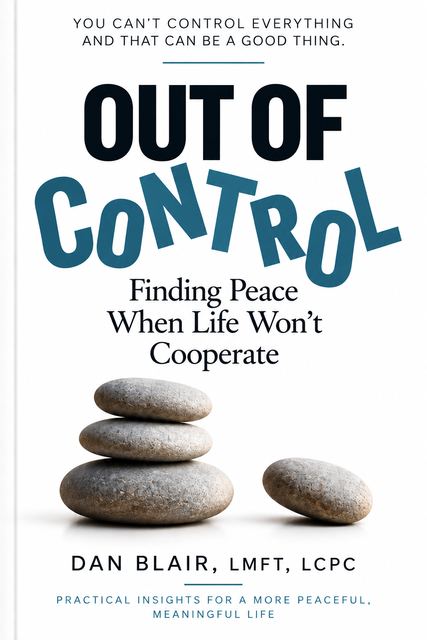
In my book, Out of Control: You Can’t Control Everything and That Can Be a Good Thing, I explore three principles that offer a different way to approach life’s difficulties: accept what is true, influence what you can, and control yourself.
Accept what is true.
Acceptance means acknowledging reality without pretending to like it, approve of it, or give up hope that things can improve.
Acceptance means I stop arguing with reality long enough to decide what I want to do about it.
Sometimes we need to grieve what we cannot fix. Acceptance gives hope an honest starting point because it allows us to respond to the situation we actually face, not the one we keep wishing were different.
Influence what you can.
You may not control another person’s choices, but that doesn’t mean you are powerless. You can communicate, set boundaries, offer support, make requests, and decide how you will participate in a relationship.
Influence matters. But influence is not control. Other people still have their own thoughts, feelings, and decisions. Recognizing that distinction can help us take meaningful action without making ourselves responsible for outcomes we cannot guarantee.
Control yourself.
This is where self-control comes in. You may not choose every emotion that arises, but you can learn to respond to your emotions rather than letting them determine your behavior.
Self-control doesn’t mean you never feel anger, fear, sadness, or frustration. It means learning what to do with those feelings. You can acknowledge an emotion without treating it as an instruction, and you can take responsibility for your behavior without blaming yourself for everything you feel.
The challenge is learning to recognize which situation you’re facing. Sometimes the best response is to accept what is happening. Sometimes it’s to try to influence it. And sometimes it’s to stop focusing on what someone else needs to do and decide what you can do differently yourself.
This Is More Than Learning to Let Go
This isn’t simply about learning to let things go. It’s about understanding why we keep trying to control our emotions, why knowing what to do doesn’t always make it easier to do it, why we can’t save a relationship by ourselves, and how we can take responsibility for our own behavior without assuming responsibility for everyone else’s.
It also explores a distinction that is easy to miss: accepting something doesn’t mean approving of it, and taking responsibility for yourself doesn’t mean taking responsibility for everyone else.
We may understand that we cannot control another person and still struggle when that person disappoints us. We may know that worrying won’t change the future and still find ourselves worrying. We may want to respond calmly and discover that our emotions are already running high.
Understanding why these patterns persist can help us find a more useful way forward.
You Don’t Have to Stop Caring
Accepting what you cannot control does not mean becoming passive, lowering your standards, or giving up on the people and goals that matter to you.
You can care deeply about your marriage without assuming you can make your spouse change. You can love your children without believing you can protect them from every mistake. You can work toward a better future without demanding certainty about how things will turn out.
The goal is not to care less. It is to stop making yourself responsible for things you cannot determine and to become more intentional about the things you can.
That shift can bring a different kind of freedom—not because life suddenly goes your way, but because your ability to respond well no longer depends entirely on whether it does.
Read Out of Control
After more than 30 years as a therapist, I’ve seen how much frustration comes from trying to control things we cannot control—and how difficult it can be to change that pattern, even when we understand it. This book brings together ideas I’ve explored through my writing and clinical work to help readers understand these struggles and approach them differently.
In Out of Control: You Can’t Control Everything and That Can Be a Good Thing, I explore how to accept what is true, influence what you can, and take responsibility for yourself—even when you can’t control the outcome.
If you’ve ever wondered why trying harder doesn’t always help, why you keep struggling with things you know you cannot change, or how to stop taking responsibility for other people’s choices, this book was written with those struggles in mind.
Get your copy of Out of Control on Amazon. You can also visit our Books page.